Favorites from 900 episodes: part 2
This is part two of our celebration of 900 Plain English lessons, where I’m sharing my nine favorite topics. In part one, we talked about “Crazy Rich Asians,” hard seltzer, Regis Philbin, and the McDonald’s Monopoly game scam. Let’s round out the list with five more favorites.
Travel
We’ve done some good travel-related episodes. Many have been about travel destinations: Toronto, the Virgin Islands, Dublin, Boston, episode 500 was about Chicago. Some lessons are about travel itself: the new rules for getting into Europe, premium economy plane tickets, and the demise of travel agents. But I have to say, my favorite in this category—I’m not saying it was the best one, I’m just saying it was my favorite one to create—was the episode about airport chapels.
This was lesson number 778. And when I had the idea, I just laughed. I knew this was going to be a good one. Why do we have airport chapels? Of all things to have in an airport, why a chapel? Of all places to put a chapel, why an airport? Here’s what I said in the episode:
The first airport chapel opened at Boston’s Logan International Airport in 1951. At the time, air travel was just starting to become accessible to the mass market, and airports began to employ a lot of people. The chapel was specifically created for the employees. Boston was—and is—a heavily Catholic area. Airport employees work long shifts, and they often have to work at times that others go to church. So the chapel at Boston’s airport offered Catholic mass to employees who couldn’t make it to church.
The chapel was given a clever name—“Our Lady of the Airways”—and pretty soon, other airports started opening chapels too. New York’s Kennedy Airport opened dedicated Catholic, Jewish and Protestant chapels.
Today, many large airports feature prayer rooms or chapels, with over 140 globally and 40 in the United States.
Technology
Episode 1—and I’m begging you to not listen to it, we have come a long way!—but episode 1 was about technology. And we have done several episodes about new tech over the years. I enjoyed reviewing the original Samsung foldable phone. We had some fun with ChatGPT when it came out. We did episodes on drone delivery, password managers, and a new way to pinpoint any spot on earth with just three words. But my favorite technology story was about QR codes.
These are everywhere now. But in late 2021, they were gaining in popularity. I think at the time you needed a special app to read them. But they were a bit of a novelty. This episode turned into a history of the barcode, and how QR codes evolved from one-dimensional bar codes. We all know QR codes, but QR codes belong to a family called “2-D barcodes.” Here’s what it sounded like in episode 425:
2-D barcodes are an improvement in almost every way. They are squares or rectangles with black-and-white dots and shapes that can relay information to a scanner. What type of information? A 2-D barcode can contain letters, numbers, and special characters. You can fit more information into a 2-D barcode than you can into an old-fashioned one. That’s why 2-D barcodes are so useful: they can generate longer strings of information, like highly complex web site URL’s.
What’s more, they’re space-efficient. They can be scanned upside down, backwards, or at an angle. They can transmit 300 times more information in the exact same amount of space as a traditional barcode. 2-D barcodes can be read by a smartphone, something almost everyone has. And smartphone cameras can now read the 2-D codes and open a browser if the codes correspond to a URL.
Language
As you know, Plain English episodes are not primarily about learning a language. They are a vehicle through which you get your English practice. But we have had some episodes that roughly fit into the language category. We have done two episodes—yes, two—about emojis: one was about how emojis figure into court cases. We did an episode about funny contractions in English like “o’clock” and “ain’t.” English words with a French origin—that was a good one. And an episode about “iel,” the gender-neutral pronoun in French itself.
But my favorite in this category was a whole episode about how to apologize. Here it is from episode 402:
Psychologists have studied the issue and they have identified six characteristics of a good apology. They are an expression of regret, an explanation of what happened, an acknowledgment of responsibility, a declaration of repentance, an offer of repair, and a request for forgiveness.
That sounds like a lot, and it is. But not every true apology needs all six of those elements. If you are ever in a situation where you need to apologize for something, consider using some combination of these six ingredients. And if you need to apologize for something really bad or really serious, then pull out all the stops and use all six.
Daily life
One of my favorite story topics is daily life, where we talk about something that we encounter every day. AM radio was a good one. We did a whole episode about places, like the U.S., where you pump your own gas. Buying a used car, the font Comic Sans, playing mahjong, neon lights in New York—no topic seems too small, sometimes, for Plain English (at least when I don’t have any better ideas that week!).
My favorite in this category has to be the episode about top sheets.
In many parts of the world, a complete bed includes two sheets: the fitted sheet and the flat sheet. The fitted sheet has elastic on the bottom and fits snugly around all four corners of a mattress. This is the sheet you sleep on, and the elastic helps it to stay firmly in place all night long. The top sheet is flat; this is the sheet you sleep under. Some people prefer to tuck the flat sheet under the mattress; others prefer to let it lay loosely on top of them. But however you do it, the layering is the same: first the fitted sheet, then you, then the flat, top sheet.
Hard as it is to believe, not every culture uses a top sheet. In fact, much of Europe has ditched the top sheet in favor of a slimmed-down bed. Most beds in continental Europe have a fitted sheet on the bottom, topped only with a duvet. The duvet is a thicker blanket, like a comforter—but the difference is the duvet has a removable cover. The duvet cover is like a giant pillowcase for the thicker blanket. And because you can wash the duvet cover frequently, you don’t need a top sheet.
Science
We talk about science sometimes at Plain English. These are the hard ones, for me, because science was my worst topic in school. My only “C” grade in all of high school was in a science class. I struggle with it; I try my best. These are not my favorite episodes, in general.
I try to keep it understandable. The world’s biggest plant was a good one—that’s episode 479. The cane toad, water on the moon, the biggest whale, a synthetic cell. All excruciating to write about! I. Do. Not. Know. Science. But there was one I really enjoyed writing: that was about snake bites.
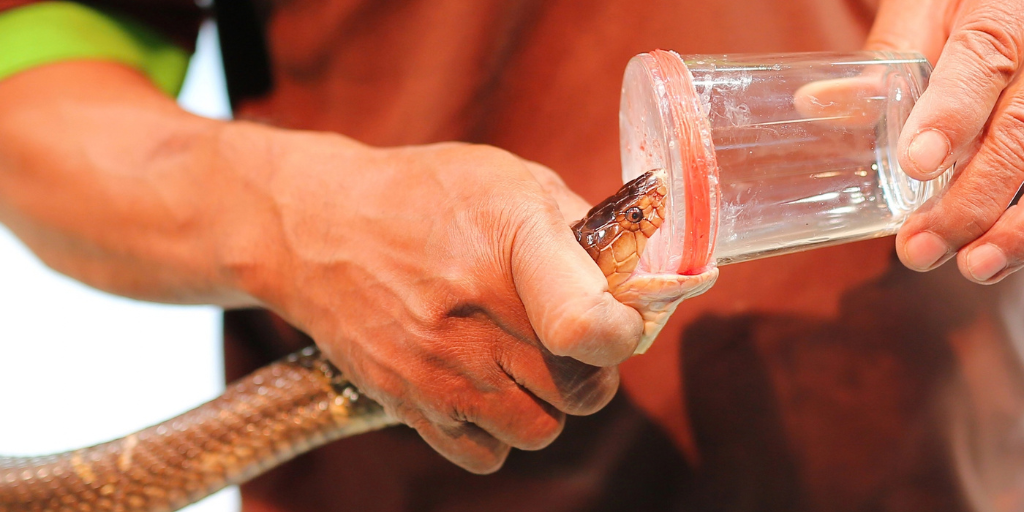
I was fascinated by this one because I learned how they make the treatment, the anti-venom. They—and you have to be a special kind of a person to do this—they take live poisonous snakes, make them really angry, so angry that the snakes bite down into a jar, ejecting their actual venom into a cup.
Then they inject that venom into a horse or a large animal. And they capture the chemicals that animal’s immune system produces to fight off the infection. That becomes your anti-venom that they give you at a hospital if you get a snake bite. It turns out, there is no universal anti-venom shot. You need the shot that corresponds to the snake that bit you! So you need to know what kind of snake bit you, and the hospital has to have that kind of anti-venom in stock. The episode was about research into a more generalized anti-venom that would cover multiple snakes. Absolutely fascinating. That was episode 818.
Jeff’s take
And that is my full list—nine of my favorite Plain English episodes. Here they are again, including last week’s: “Crazy Rich Asians,” hard seltzer, Regis Philbin, the McDonald’s Monopoly game scam, airport chapels,QR codes, how to apologize, top sheets, and anti-snake-venom.
And on this nine hundredth episode, I would like to also acknowledge two people who help me every week. JR is the producer. He is the reason you hear the audios every week. He gets the content up on the website and helps me on the live calls at PlainEnglish.com. And Constanza, an English teacher in Argentina, helps me with the translations and exercises each week.
So a big thank you to JR and Constanza for their help here at Plain English every week.
Great stories make learning English fun