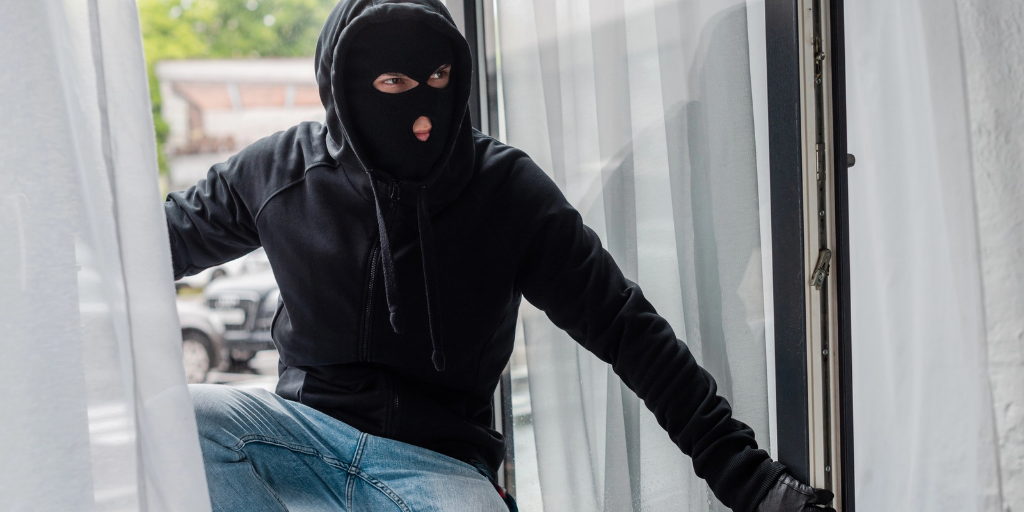
New way to catch burglars: DNA in the air
A home burglary can be over in just a couple of minutes. The average home burglary lasts just fifteen minutes—which means many are over in much less time than that.
Thieves are clever, too. They wear gloves so as not to leave fingerprints and they cover their hair to prevent leaving strands behind. And even if their unwelcome presence is detected by an alarm system, they’re usually gone before the police arrive.
It’s enough to make a burgled homeowner throw up their hands: how can police possibly solve a crime like that?
The answer might be floating in the air.
We all know that our cells carry DNA, a unique personal identifier. DNA stored in spots of blood and strands of hair has been used to solve crimes for decades. More recently, scientists proved that just touching a surface often leaves DNA behind. And in 2022, a team of scientists found that simply being in a room can leave traces of DNA suspended in the air.
It’s true. In an experiment, a research team from Oslo, Norway analyzed the air in a typical office. They compared DNA collected from the air with samples given by the people who worked there. They were able to identify the office workers simply by the material floating in the air.
How is this possible? People shed microscopic amounts of skin cells, dandruff, and saliva into the environment, and some of that material can stay suspended in the air for a few hours. Even if you’re fully covered, skin cells can pass through your clothing and become airborne.
Then one of the researchers in the office study, Chiara Fantinato of Oslo University Hospital, turned her attention to the world of crime. If she could identify people who worked in an office just by DNA suspended in the air, would it be possible to learn the identity of a home burglar in the same way?
She led an experiment with a partner team from the other side of the world, Adelaide, Australia. They performed an experiment on 22 houses, 11 in each city. They enlisted some mock “intruders” to pretend to break into the homes (don’t worry: the homeowners cooperated, and nothing was really stolen!).
The researchers paid an initial visit to the homes and collected air samples to use as a baseline. As they suspected, they found DNA evidence of the residents and their relatives in the air. Then, they set the “intruders” loose.
The “intruders” had never been in the homes. Each entered the home after residents left, and spent 15 minutes in the kitchen. They did things burglars might do: they opened cabinets, rifled through drawers, and touched various surfaces. They wore ordinary clothes with no gloves or masks and they were allowed to talk while they were in the house.
Researchers waited 30 minutes, and then went in. The researchers themselves wore coveralls, hair nets, gloves, masks, and shoe covers, because they didn’t want to contaminate the sample. To gather evidence, they used an air sampler; it’s like a vacuum cleaner that sucks in air instead of dust. They set it on a camera tripod in the kitchen and let it run for two hours. While they were at it, they also took samples of dust and surfaces.
Here’s what they found. In Oslo, they identified the intruder’s DNA in the air in nine out of eleven homes; in Adelaide, they found it in four of eleven homes. The intruder’s DNA was easiest to identify in a home that had been cleaned the day before.
The results were not a slam dunk. Fewer intruders were identified in Adelaide than in Oslo; the research team speculates it may be due to differences in climate: it was cold in Oslo, but hot and humid in Adelaide, where air conditioning was likely to be on. The different labs may have used different techniques to analyze the samples. It might also have simply been random variation.
The research team says it has spoken to police forces about potential future use. Real-world use would be more complicated: not all burglars would talk, or forego gloves. And the air samples in the study were collected within 30 minutes. It seems unlikely the police would be able to set up an air sampler so quickly.
And any results would have to be interpreted correctly. DNA evidence is often presented as definitive. And in some ways it is: it is very reliable in matching a person with material collected. But DNA travels quickly, and finding a person’s DNA in one area is only a clue, not definitive proof that they did anything wrong.
Still, airborne DNA may one day be used as an investigative tool, alongside other tools. If your DNA were found floating in the air of a house that had just been burgled, you might have some explaining to do.
Jeff’s take
The options for getting away with crime are dwindling. If you want to break into a home, you have to wear gloves. That’s a given—fingerprints. You’ll also want to wear a mask, in case there’s surveillance video.
You’ll want to cover your skin—but now we learn that microscopic dead skin can pass through clothing and be suspended in the air! So, on your next break-in, maybe try wearing a wetsuit?
Even then—everyone has to breathe; you can’t have traces of your saliva in the air when you leave. It’s almost enough to scare you straight!
Learn English the way it’s really spoken