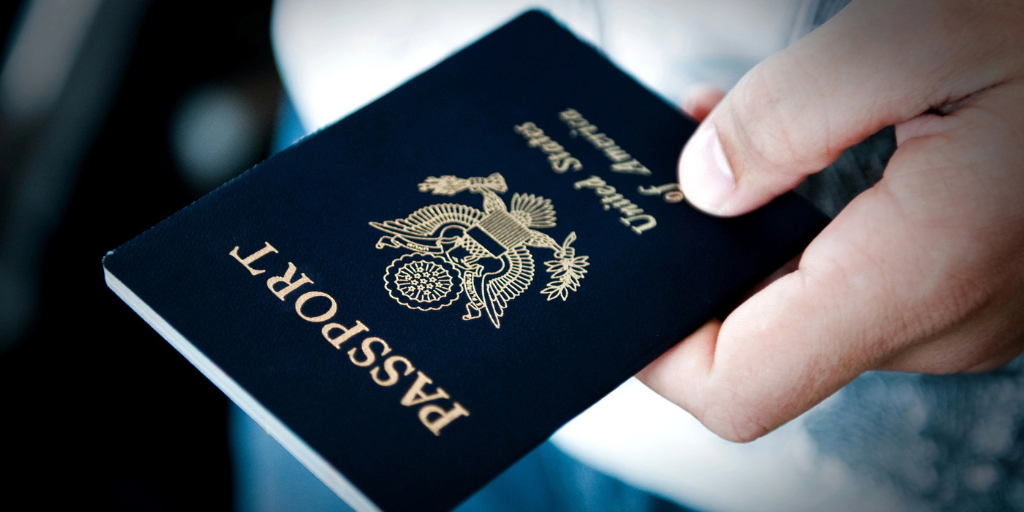
What citizenship do you get at birth?
On the first day of his second term as president, Donald Trump signed an executive order that put limits on the way the United States gives citizenship to children born on American soil.
The U.S. has a system of “birthright citizenship.” That means that any person born inside the country’s borders is automatically a citizen. There are very few exceptions—for example, children of diplomats working at foreign embassies are not citizens automatically. But the concept of birthright citizenship has been the law in the United States since 1868, and it’s in the constitution.
Now, Trump wants to change the interpretation of that law. It’s complicated—but the simple version is he wants to stop granting citizenship to children of undocumented immigrants and those on temporary visas. He argues that this limitation is allowed under the current law. The order has been challenged in court. Most legal observers agree Trump’s interpretation of the law is incorrect and will be overturned eventually—although it’s not certain.
When he signed the order, Trump said the U.S. was the only country that offered birthright citizenship. He claimed undocumented immigrants were taking advantage of the system by coming to America just to have children.
He was not correct when he said the U.S. is the “only” country that offers citizenship to children born on its soil. But neither is birthright citizenship the worldwide norm. In fact, there’s a pretty clear geographical split between countries that offer it and those that don’t.
Almost every country in the Americas offers birthright citizenship; almost every other country in the world does not. There are some interesting historical reasons for this.
The modern equivalent of birthright citizenship started in the United States. It came after the abolition of slavery. The Fourteenth Amendment to the constitution gave citizenship to formerly enslaved people, their children, and anyone born inside the country’s borders in the future. It guaranteed that race, ancestry, or social status could not affect the citizenship of a child born in the country. At the time, this was the world’s strongest and clearest law on birthright citizenship.
After the nations of Latin America won independence from Spain and Portugal in the 1800s, they, too, began to adopt birthright citizenship—but for different reasons.
For them, it was about nation building. These were new countries that needed to define who was in and who was out. Here are two important reasons that many former Spanish and Portuguese colonies gave birthright citizenship: to encourage immigration and to integrate indigenous communities.
First, immigration. Compared to Europe, the vast territories of Latin America were sparsely populated. The new countries wanted to encourage immigration, so they used birthright citizenship as an incentive. Any Europeans that came to Brazil or Argentina, for example, could come knowing that their children would be citizens in the place they were born.
Another reason was to give citizenship to indigenous populations. These new republics needed to unify diverse groups under a single national identity, and granting citizenship by place of birth was one way to include indigenous people into the newly-formed nations.
Canada was late to the party for other, historical reasons, but it passed unconditional birthright citizenship in 1947. Today, Colombia is the only large country in the Americas without it.
So that’s how things work in the “new world.” But what about the rest of the world—Europe, Africa, and Asia? How do they handle citizenship for children?
The answer is through the nationality of the parents. This is called citizenship by descent. Almost every country offers citizenship to children based on the nationality of the parents. For example, a child born in France to two French parents is automatically a French citizen. That’s because France offers citizenship to the children of its own citizens. That’s an easy example.
But imagine a girl is born in Switzerland. Her father is German and her mother is Dutch. In this case, the girl becomes a citizen of both Germany and the Netherlands—the nationalities of her parents—but not a citizen of Switzerland, the place of her birth.
So the vast majority of children obtain some type of citizenship automatically when they are born—it’s just not necessarily from the place where they first entered the world. Depending on the country’s rules, children may be able to apply for citizenship later in life if they’ve lived in their birth country long enough.
Almost every child will get some type of citizenship at birth, either from descent or birthright. Almost—but not every child. Some countries don’t allow women to pass along citizenship to their descendants. Lebanon, Syria, and Saudi Arabia are examples.
So imagine a Syrian mother gives birth to a child in Europe, and the father is absent or unknown. The European nation would not grant the child citizenship just for being born there. And Syria does not allow the mother to pass along citizenship to the child. The child would be born stateless—a citizen of no country.
This is rare, but it happens. There are two international treaties that address statelessness. The first aims to protect stateless people, ensuring they have access to basic rights like education, work, and a legal identity. The second focuses on preventing statelessness, especially in children, by encouraging countries to grant citizenship to those who would otherwise be born without a nationality.
Jeff’s take
Honestly, I was very surprised to learn that most of the world does not practice birthright citizenship. It’s just one of those bedrock principles of the law in the United States, and I would have thought countries with similar legal traditions would have had it.
Some countries have repealed it. The U.K. and Australia had birthright citizenship until the mid-1980s. Ireland and New Zealand tightened their citizenship laws in the early 2000s.
We talked in episode 121 about birth tourism; that was about concerns in Canada that people were flying to Canada, having a baby, and then going right back home again. People would do this to give their children Canadian citizenship and the right to low-cost education in the future, even though neither the child nor the parents had any connection to Canada. That seems like a pretty blatant abuse of the system, but it’s not very common.
I like the idea of birthright citizenship. It’s very popular in the United States. Recent surveys showed over 50 percent of people are in favor of granting citizenship to anyone born in American territory, while only about 30 percent oppose it.
For me, it’s about one of the ideals of America: that it doesn’t matter where you came from, it doesn’t matter who your parents are, what they did, what their jobs were, if they were married—none of that matters. Your personal story starts on the day you were born. That’s not an ideal we always live up to, but, I think, it is a worthy one.
Learn English the way it’s really spoken