The past and present of marathons
A marathon is a road race of 42.2 kilometers, or 26.2 miles. And it has a rich legend behind it. It was the year 490 BC, when the Greek army defeated a much larger invading Persian army in the Battle of Marathon. A Greek messenger ran 26.2 miles from the site of the battle to the city of Athens to deliver the good news. He burst into the Athenian assembly, called out, “We have won!” and then promptly died of exhaustion. To honor this brave soldier, a 26.2-mile race has been established.
That’s the legend. The reality is a little different. There was a famous messenger, who ran long distances. There is no evidence that he delivered the message of victory, or that he died after doing so. But he did run, not 42.2 kilometers, but 246 kilometers shuttling information between Athens and Sparta.
Still, the ancient Greeks had the good sense not to run 42 kilometers for fun.
Fast-forward approximately two thousand years. At the 1896 Olympics—the first modern Olympic Games in Athens—an historian proposed a long-distance run to honor the legend of the run from Marathon to Athens. The course at those first Olympics ran from the town of Marathon into the main stadium in Athens. It was about 40 kilometers.
The exact length of the modern-day marathon was set at the 1908 Olympics. At these London Olympics, the Royal Family wanted to watch both the beginning and the end of the race, so they ordered the course extended. The precise length—twenty-six miles, 385 yards—allowed the family to watch the beginning at Windsor Castle and allowed Queen Alexandra to see the end right in front of her viewing box. And that is how we get the modern length of the marathon 26.2 miles, or 42,195 meters.
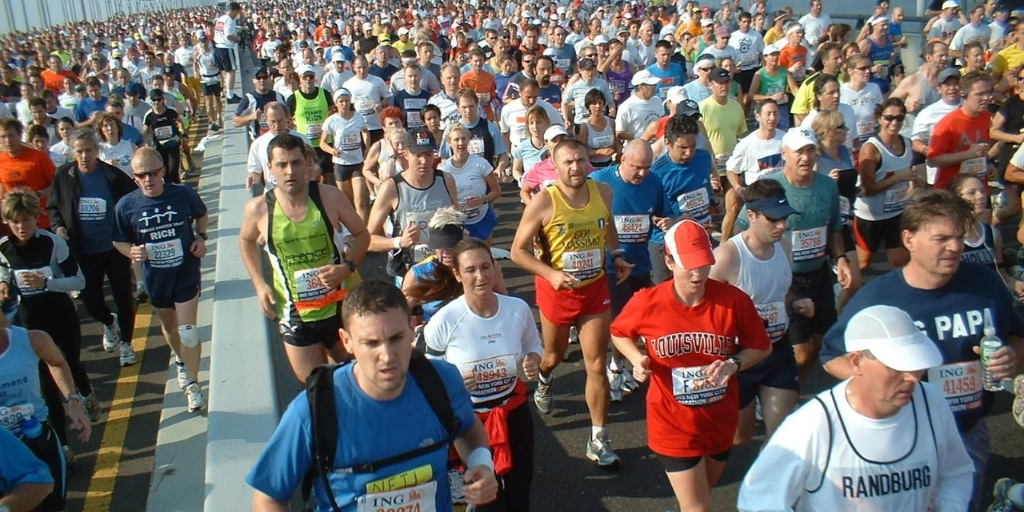
Today, marathoning is still an Olympic sport. But it is also a popular recreational activity. These days, about 1.2 million people finish a timed marathon every year. They range from competitive athletes, with elite sponsorships, to average Joe’s trying to get in shape—and everything in between.
There are thousands of organized marathons per year. The biggest ones can swell a city’s population for a weekend, close its roads, and generate millions of dollars in tourism and publicity. The smallest marathons can feel like a sweaty neighborhood block party.
Fall is marathon season. October and November are the most popular months for marathons; runners like the weather to be cool, but not cold. Cloud cover helps.
There are eight major marathons that make up the Abbott World Marathon Majors—like an informal championship tour of the best world marathons. They are Sydney, Berlin, Chicago, New York, Tokyo, Boston, London, and, starting in 2027, Cape Town.
These major marathons are a big deal in their host cities. Organizers are up early on race day, preparing the course, closing the roads, and setting up metal barricades for crowd control. They set up medical tents and hydration stations; they mark the route; and they guide runners to the starting line. Police work the route on foot and on bicycles.
Roads are closed early in the morning, and open again after the last wave of runners has passed. When it’s all done, sanitation workers spend the night cleaning up in preparation for the morning commute the next day (marathons are usually on Sundays). An exception is Boston, where the marathon has its own Monday holiday (it’s officially called Patriots’ Day, but people call it Marathon Monday).
Because marathons are spread throughout the city, they have a wide economic impact. Small shops and restaurants throughout the host city, and hotels far from the starting line, are all busy on marathon weekend.
The major marathons are famous for their size. But there are good reasons to run smaller marathons, too. The Great Wall Marathon takes place, in part, on the Great Wall of China. Runners have to climb 5,000 stone steps of the wall. Their reward, though, is a six-kilometer stretch of the race on the top of the wall.
Runners at the Lewa Safari marathon in Kenya run alongside elephants, lions, and rhinoceroses—and no fences.
Some marathons offer unique prizes. In Napa Valley, California, finishers get their weight in wine. (Napa Valley is a winemaking region.) Finish a marathon in Patagonia, Chile, and they’ll plant a tree in your honor.
The northernmost marathon is in Tromsø, Norway: it starts at 8:30 p.m., but even so runners cross the finish line in daylight. The southernmost is on the continent of Antarctica. The 2025 edition was the twentieth anniversary of this extreme race. Runners pay a $22,000 entry fee, fly from Chile and land on an ice runway carved into a glacier. The race is four loops of about 10.5 kilometers on groomed ice; runners can see the Ellsworth Mountains the whole time.
Temperatures in December—the southern summer—are between minus-twenty and minus-ten degrees Celsius. Runners wear special shoes, thermal layers, a windbreaker, gloves, mittens over gloves, a hat, goggles, and more.
Jeff’s take
A few other marathon stats for you. The average marathon finishing time is four hours, thirty-four minutes. The marathon with the highest demand is London. The London Marathon received 1.3 million entry requests for the 2027 race: about twenty times more entries than spaces typically available. Organizers responded by making it a two-day race, with one run on Saturday and another on Sunday, and a total capacity of around 100,000 runners.
I have run three marathons, all of them when I was either in college or recently graduated. None of them were big.
I ran the Steamtown Marathon in Scranton, Pennsylvania twice. This was before Scranton became famous for being the home of “The Office” television show. That was a lot of fun. Scranton is a small city, but the surroundings are really pretty. It’s in a very scenic part of the country. A lot of the race was on rural roads through the forests, and it finished in downtown. The marathon was a big deal in town. People were cheering on runners from their driveways. There was great camaraderie among the runners. It was a lot of fun.
The other one I did was called the “Our World is Flat Marathon” in Columbus, Ohio. This was a nod to the fact that Columbus is relatively flat, with few hills—and also a nod to the city’s namesake explorer. Although I can tell you, it didn’t feel flat to me, at least not the last stretch.
Learn English the way it’s really spoken