What’s it like when the sun never sets?
When you think of the word “summer,” you probably think of the temperature: in most places, summer is the hottest season. But for many people, summer also means longer days. And the farther you get from the equator, the more daylight you get in summertime.
At the equator, every day has about the same amount of sunlight. Dawn and dusk are short: the sun seems to rise and set quickly. At the Arctic Circle, things are quite different. During the summer, the sun never fully goes below the horizon. Even in the dead of night, it’s light outside.
Of course, not many people live above the Arctic Circle. But millions of people in Scandinavia, Russia, Canada, and Alaska get some sunlight all night long in the summertime. And this can shape the experience of living there.
If you like being outside, especially in pleasant weather, long summer nights can be a dream. In Fairbanks, Alaska, they’ve been playing the Midnight Sun baseball game since 1906. The game starts at 10:00 p.m. on the summer solstice, and ends around midnight—no outdoor lights required.
In Sweden, Midsommar, the summer solstice, is a national holiday. Shops close, cities empty out, and people go to cabins in the countryside to enjoy the long days, warm weather, and beautiful surroundings. Reykjavik hosts a music festival on the longest days of the year; bars and clubs stay open later. Partiers leave the bars at two, three in the morning and it’s still light outside.
Tromsø, Norway is one of the northernmost cities in the world, at 69 degrees north latitude. It hosts an entire festival season around the summer solstice.
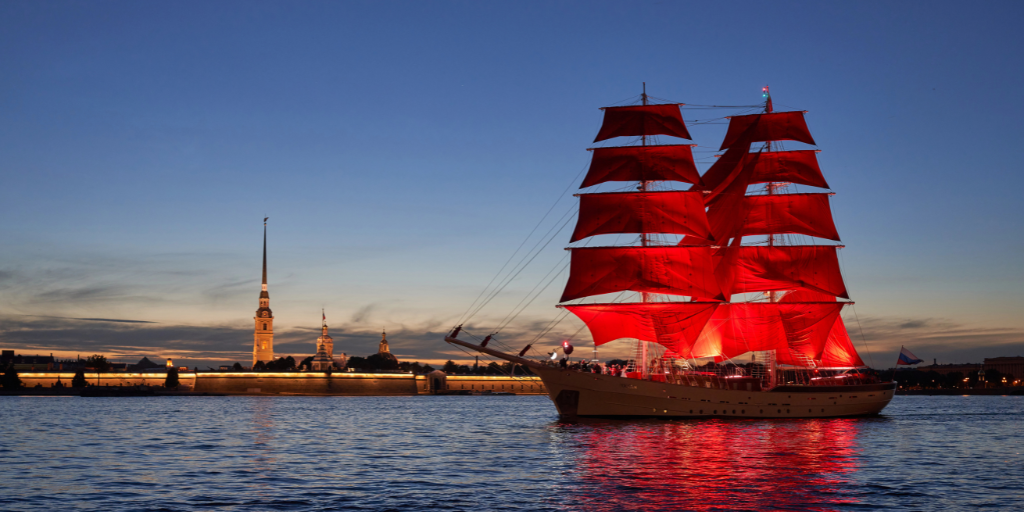
St. Petersburg, Russia, is the largest city to experience daylight at night. Five million people live at 59 degrees north latitude, where the sun is up for almost nineteen hours on the longest day, and it doesn’t get fully dark at night. Locals say that the long, extended sunset transitions directly into a long, extended sunrise.
They call this season the “White Nights.” Fyodor Dostoevsky wrote a famous story called “White Nights.” The city comes alive after midnight: residents crowd the riverbanks and watch the bridges open and cargo ships pass through between 1:00 and 5:00 a.m.
The summer solstice is also graduation season, and the Scarlet Sails festival celebrates new high-school graduates. A tall ship with scarlet-colored sails sails along the Neva River, while the city’s symphony performs outdoors, bands play on multiple stages, and fireworks go off—it starts at 1:00 in the morning.
That all sounds fun. But it comes at a cost: it can be hard to adapt to a world with little to no darkness.
Our bodies regulate sleep with the transition from light to darkness. The hormone melatonin is released in darkness. But if it never gets truly dark, the body’s melatonin production gets postponed, making it harder to go to sleep.
So people who live with extended daylight have to adapt. The built environment helps. Homes in Finland, for example, are designed to let as much daylight as possible into the house—this is to help in those opposite months, without much sunlight. But the windows are all equipped with heavy blackout curtains that block out all the sunlight from outside.
And those are not just in the bedrooms. Double curtains are common even in living rooms and kitchens, so your body can adapt to darkness in the hours before bedtime.
Even restaurants do this. In Iceland, it’s common for restaurants to close their blackout curtains and dim the lights, to imitate a nighttime experience. Of course, you do still have to leave—and you can walk outside at 11:00 p.m. to sunshine.
Some people really do struggle with the changes in daylight. Melatonin supplements are available, though in Scandinavia they are by prescription only.
Still, most people are able to adapt fairly well—not just to long days, but to short ones as well. Remember Tromsø, Norway? About 80,000 people live there. And from about May 20 to July 22—two months—the sun never sets at all. And from mid-November until mid-January, the sun never fully comes up—it’s just twilight during mid-day.
For this reason, Tromsø is one of the most-studied places on earth for sleep. And a big study found that there wasn’t much seasonal variation in the amount of sleep people got.
Jeff’s take
I’ve never been really far north in the summer. But I grew up in a town that was about 41 degrees north latitude, and that’s about where Chicago is, too, where I’ve spent many years. It’s about even with Barcelona or Rome. And the sunlight affects a lot, it affects the rhythm of the year.
I love it when it’s still light at 8:00, still some daylight peeking through at 8:30, 8:45. Especially when the weather is nice, it’s nice to be outside later in the evening.
But here’s one thing. I don’t like blackout curtains. I like to wake up with the sun coming in my windows. So I don’t know what I’d do in Helsinki when sun comes up at about 3:50 a.m.
Learn English the way it’s really spoken