Can New York ever fix Penn Station?
The island of Manhattan, in New York City, is the beating heart of American culture and commerce. About 1.6 million people live on the island, but the daytime population swells to four million with commuters from a three-state area. And right in the middle of Midtown Manhattan, between Seventh and Eighth Avenues, and from 31st Street to 33rd Street, is the country’s biggest, busiest train station, Pennsylvania Station.
Riders use Penn Station to go to the suburbs of New Jersey and Long Island, to connect at high speed to Boston and Washington, D.C., and to take long distance trains as far as Los Angeles and Miami.
Penn Station was built in 1910, during the golden age of America’s railroads. So you might be imagining a beautiful, Beaux Arts building, with soaring ceilings, huge windows, granite and marble—all the grandeur of the nation’s great early twentieth century train stations. You might be imagining a station on par with Grand Central Terminal across town, where travelers from around the world look in awe at the detailed ceilings, snap selfies with the famous clock in the background, and dine on fresh oysters.
If you’re imagining a Penn Station something like that—you’re right. It was just like that. It was an architectural masterpiece, bathed in natural light, with a pink granite façade and elegant columns. It was—until it was torn down in 1963.
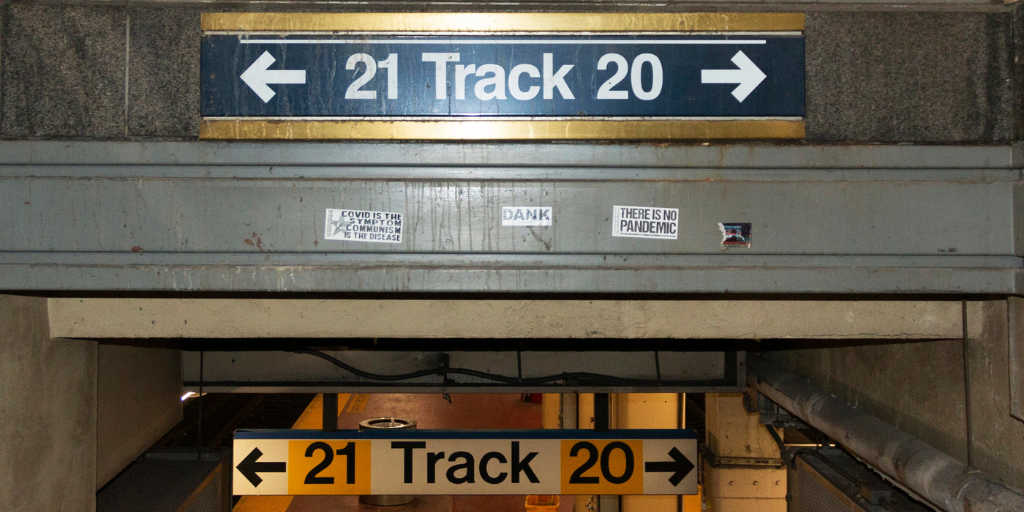
Today, Penn Station is buried underground with not a single window. It’s a confusing maze of low-ceilinged corridors lined with cheap shops and fast food. No oysters here: if you’re hungry, you’ll probably have to scarf down a piece of pizza standing up.
It is the place that New Yorkers love to hate. The city always thinks big, looks up, builds high, and aims higher. But the busiest train station in the city, the station that connects New York to the nation’s capital and beyond, that station is a decaying, depressing underground bunker. The destruction of the original Penn Station in 1963 is considered one of the gravest mistakes in the city’s architectural history.
And generations of New York leaders—mayors, governors, city planners, transit directors, real estate developers—they’ve all dreamed about restoring Penn Station to its previous glory. And one plan after another has failed.
Both architectural and political factors are standing in the way of any plan to rebuild Penn Station.
Start with the architecture. Shortly after the original Penn Station was torn down, the concourses and waiting areas were moved underground so that an arena could be built where the station once stood. That arena is called Madison Square Garden. It’s home to New York Knicks basketball and New York Rangers hockey, and it hosts major concerts, boxing matches, and events. The Garden bills itself as “the world’s most famous arena” (and it might even be right about that).
To support a 20,000-seat arena, more than 1,000 beams had to be driven deep into the ground, slotted in between the train tracks far below. And now, sixty years later, these support beams are a primary reason why the tracks can’t be reconfigured, or why the platforms and concourses can’t be widened. The beams are quite literally holding up the world’s most famous arena.
Then there are the political obstacles—and these might be even more formidable than 1,000 beams drilled into bedrock. Three transit systems use Penn Station: one for commuters to New Jersey, one for commuters to Long Island, and one for long-distance passengers bound for other cities. Each system has its own agency head, and each agency reports to a different political leader: two state governors, and one cabinet agency in Washington.
Amtrak, the national train system, owns the station. But they only own what’s underground. A powerful media company owns the arena on top of it. That means, for anything to happen at Penn Station, three governments and one private landlord all have to agree.
Over the years, various ambitious New York State governors have promised to fix Penn Station. One governor, Eliot Spitzer, came tantalizingly close in 2008. He got the arena’s owner to agree to build a new Madison Square Garden across the street. That would make room for a new Penn Station above ground. But before he could finalize the deal, the governor was forced to resign in a sex scandal. Without anyone pushing for the plan, the deal collapsed.
Now, the federal government wants to try its hand at finally fixing Penn Station. The Trump administration has taken control away from New York State and put a respected transit executive in charge of the project. But these are still early days: a final plan hasn’t even been agreed upon. Scratch that: a preliminary plan hasn’t even been agreed upon. Step one is to solicit ideas from developers. That’s happening now. The government confidently projects that construction on a new Penn Station will start in 2027.
Jeff’s take
I have spent more hours than I care to admit in Penn Station. When I lived in New York, I took the New Jersey trains frequently. The platforms are so dark and narrow that they don’t want anyone waiting on the platform for the train. So they don’t announce the track until right before the train leaves.
And what people do is, they wait in these crowded waiting areas, almost always standing up. The waiting areas might have a few dozen seats to serve hundreds, maybe thousands of people. So almost everyone is standing up. And they stare at the screens in the minutes before their train leaves. And the moment the track number shows up on the screen, people bolt to the stairway that leads down to their track, jockeying for position, trying to get to the train in time to get a seat.
To address this type of overcrowding, Penn Station does have a new waiting room. It’s in the old Post Office building on Eighth Avenue. That was designed by the same architectural firm and was built in the same style as the original Penn Station.
I have not been there, but it’s supposed to be beautiful. There’s a grand, light-filled waiting area with new places to eat. So you can wait for the train there, enjoy the classic architecture, and then go down the stairs to the same old ugly, narrow tracks as always. But at least the time you spend in ugly old Penn Station is limited.
Oh, that new Train Hall cost $1.6 billion. So I can’t wait to see what the redesign of the actual station will cost.
Great stories make learning English fun