Route 66 and the American road trip
It’s no secret that Americans are in love with their cars. You might also know that we’re in love with a particular type of travel: the road trip. On a great American road trip, you throw your bags in the trunk, pack a cooler of lunches, open up a map, and start driving down the open road: who knows where you’ll wind up?
Because on a great road trip, the journey is the destination. You stop along the way at interesting attractions, places you might not have known about had you not driven by. You meet interesting people at diners. You stay at economical road-side motels. You see the landscape—the desert, the farms, the mountains—up close and in person.
You can trace the origin of this love story back one hundred years exactly, to the founding of Route 66. A hundred years ago, over the road travel was much different than it is today. Private associations stitched together roads and marketed them to travelers, all to help improve business along the road. Long roads competed with one another, and they didn’t connect in logical places.
But in the early 1920s, the federal government stepped in to standardize national roadways. The national government would split the cost of road maintenance with the states. And travelers would benefit. Now, they would have a coherent, easy-to-use system of national highways.
In 1926, these new national highways were given numbers. Route 1 went up and down the east coast; Route 40 connected San Francisco to New Jersey; and Route 66 went from Chicago to Los Angeles.
All these national roads were important because they formed a network of highways that improved commerce and let travelers experience the interior of their country, not just the big cities.
But Route 66 was especially important. It cut diagonally through the American interior, mostly rural states like Missouri, Oklahoma, Texas, and New Mexico. It brought prosperity to farmers, who could now bring their grain and produce to the market more easily.
Route 66 also facilitated migration during an especially hard time in our national history.
The Dust Bowl was a ten-year environmental disaster that struck the Great Plains, in the middle of the country. Years of over farming had loosened the topsoil in the plains. So when a severe drought hit in the early 1930s, massive windstorms blew the loose topsoil all over the region, covering towns and farms in thick dust. This went on for many years.
The Dust Bowl coincided with an economic depression. Many farmers simply could not continue where they lived. Hundreds of thousands of residents left their homes, and they used Route 66 to go west to California.
In 1938, Route 66 became the first fully paved highway in the United States. That proved useful just a few years later during World War II, when large trucks transported military munitions from the ports in California to the factories in the Midwest and the eastern United States.
After World War II, Americans had the wealth to own their own cars, and the family road trip became a popular option for middle-class vacations.
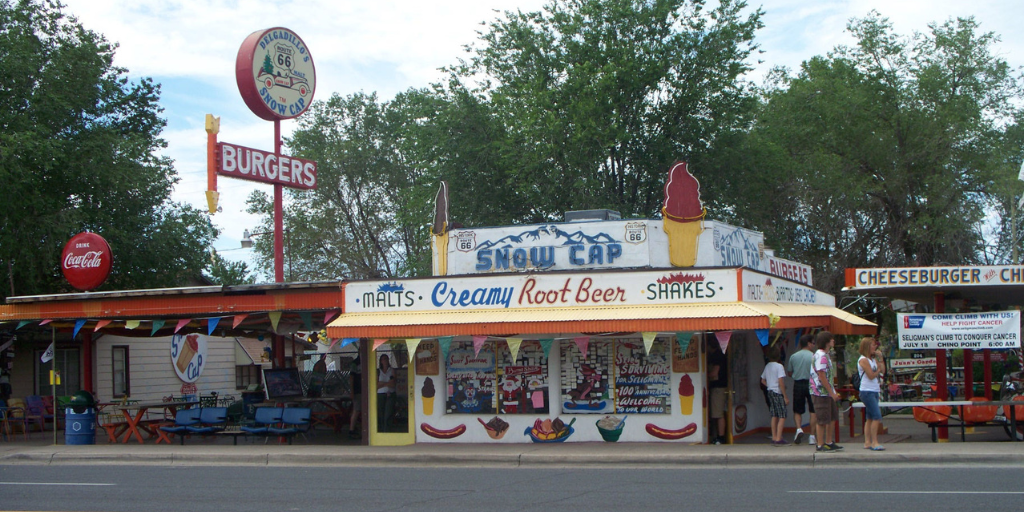
Route 66 transformed itself into a linear tourist destination, with neon signs, roadside attractions, campgrounds, and family-friendly motels with swimming pools.
By this time, it had also established itself in the American imagination. It was called the “Main Street of America.” John Steinbeck’s famous novel, “The Grapes of Wrath” traced a Dust Bowl-era family as it fled the drought along Route 66.
And then, there was the song. In 1946, the singer Nat King Cole released the song, “Get Your Kicks on Route 66” and it became a hit. “If you ever plan to motor west,” he sings, “Take the highway that’s the best.” Later, a TV show called simply “Route 66” brought the road into American living rooms every week.
Route 66 is no longer the best way to motor west, from Chicago to LA, like it was in Nat King Cole’s time. In fact, it’s no longer an official highway. Most people who drive that territory take interstate highways, large, fast expressways that whisk travelers past small towns at high speeds.
But many of the individual sections of roadway that once made up Route 66 are still there—and some stretches remain popular with tourists. This year, as the route marks its one-hundredth anniversary, towns and cities along the road are celebrating a century of road trips.
The city of Albuquerque, New Mexico, is helping to pay to refurbish the neon signs on its 18 miles of Route 66. Other places are sponsoring mural contests and opening museum exhibits. Business owners are already enjoying a boom in Route 66 tourism.
The official anniversary will be November 11, 2026—one hundred years after American Association of State Highway Officials adopted the numbered highway system.
Jeff’s take
When Route 66 became a popular tourist road, entrepreneurs competed for their attention. The neon signs are the most famous. But here is a selection of other roadside attractions that popped up along route.
The Devil’s Rope Museum is a museum dedicated to barbed wire. The World’s Largest Rocking Chair—it’s 42 feet high—is in Fanning, Missouri. Cadillac Ranch is an area of the desert where ten vintage Cadillac cars are buried nose-first in the sand. Visitors can spray paint any design they want on the cars. Also, the Wigwam Motel—every room is in the shape of a wigwam.
And in Amarillo, Texas, there’s a restaurant called the Big Texan. And at the Big Texan, they have a competition. If you can eat a full, 72-oz steak—that’s a two-kilogram steak—if you can finish the whole thing, then your meal is free. But that’s not all. You have to do it in an hour. And you have to finish all the side dishes! So it’s a huge steak, plus shrimp cocktail, a baked potato, a garden salad, and a dinner roll. With butter. In an hour.
I have been there. No, I did not try to eat a 72-ouce steak. If you fail to clean your plate, you have to pay for the steak. It’s not cheap, it’s $72 if you don’t finish. And it’s not for people who are shy, either. If you try the competition, you have to sit at a special table with bright lights all around, and a huge clock above you counting down the minutes until you finish. And I think these days the table is live streamed, so your meal is broadcast over the internet.
About a hundred thousand people have attempted to eat the 72-ounce steak and only about twelve percent of people do successfully finish.
This is the kind of thing you encounter on Route 66. This is what the American road trip is all about. I went to the Big Texan on a road trip myself; it was a road trip from New Jersey to Los Angeles, and a large part of our itinerary—I did it with a friend in college—a large part of our itinerary took us along the original route 66.
If you get a chance to go, I recommend it—even if you just stop in one or two of the towns along the original route, in the Midwest or the Southwest. They can be a lot of fun.
Learn English the way it’s really spoken